Mix and match deals that actually move product
Multi-buy prices, percent off, dollars off and buy-more-save deals: which ones work in a liquor or convenience store, how to keep your margin, and how to set them up so cashiers never have to remember.
Arjun ChemparathyPublished 4 min read
The deals that move product in a liquor or convenience store are simple, on items people already buy, and ring up the same way every time. Pick a few fast movers, choose the deal type that fits, put it in the register so it applies by itself, and tell customers at the shelf.
The five kinds of deals
| Deal | Example | Works well for |
|---|---|---|
| Multi-buy price | 2 for $5.00 | Energy drinks, single beers, snacks: items people grab two of |
| Percent off | 20% off | A category or brand for a week, slow movers |
| Dollars off | $1.00 off | One product, a distributor-funded price drop |
| Buy more, save a percent | Buy 2, 10% off | Wine and spirits, case discounts |
| Buy more, save per item | Buy 2, $0.50 off each | Six-packs and multi-packs, mixed cases |
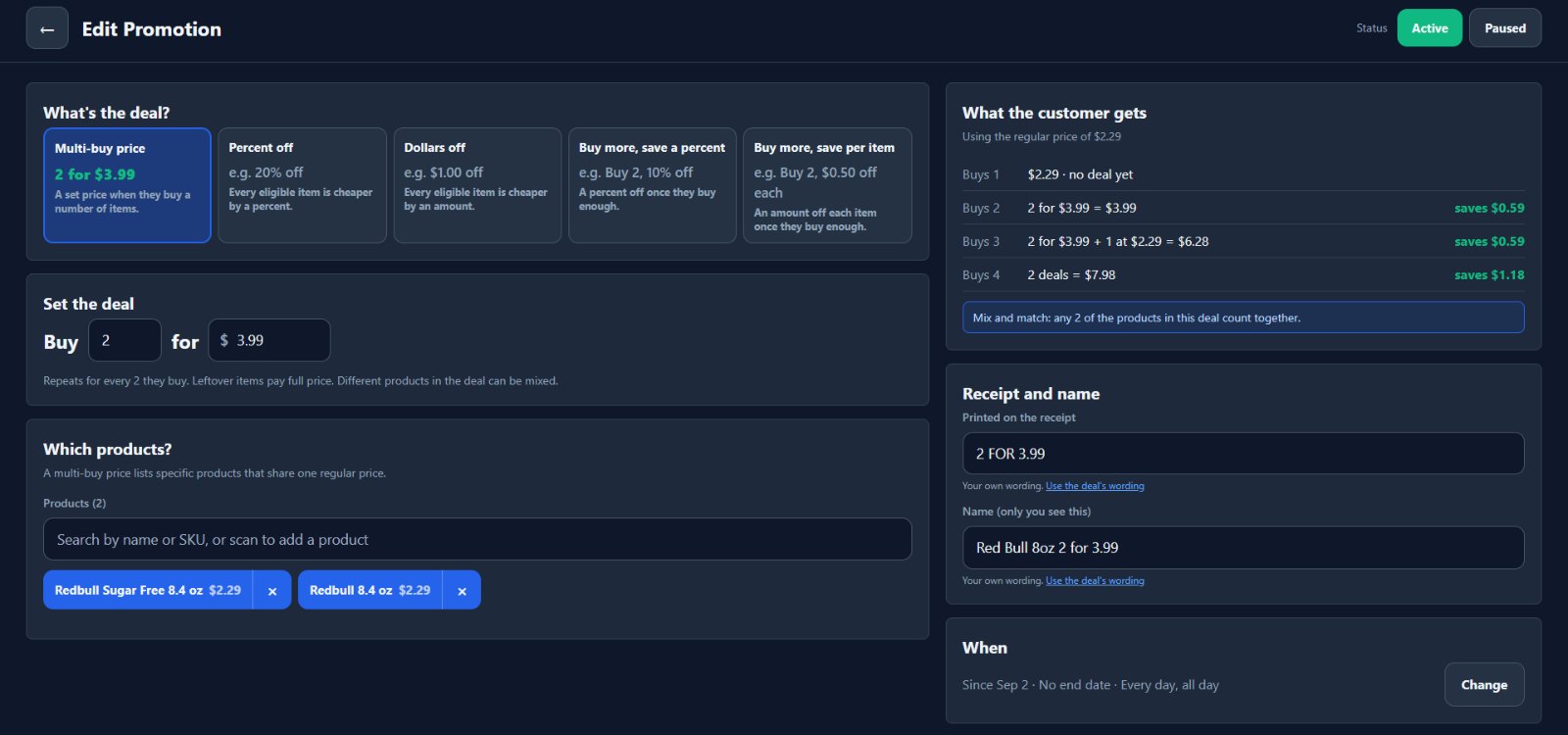
These are the five choices on Ceyyo's "What's the deal?" screen.
Mix and match
Mix and match lets customers combine different items to reach the deal. "Any 2 for $5.00" on a brand's energy drinks means a customer can take one of each flavor. It works best when:
- the items are priced the same (Ceyyo requires the same regular price for a multi-buy price, so the deal adds up),
- they sit together on the shelf, and
- the sign says "mix and match" in big letters.
Keep your margin: do the math first
Before you run a deal, check what you keep. Two examples with made-up numbers:
Multi-buy price. An energy drink sells for $2.99 and costs $1.80. "2 for $5.00" is $2.50 each, so you keep $0.70 a can instead of $1.19. The deal pays if it sells at least 70% more cans (1.19 ÷ 0.70 = 1.7), or if it brings in customers who buy something else.
Buy more, save a percent. A bottle of wine sells for $14.99 and costs $10.00. "Buy 2, 10% off" makes it $13.49, and you keep $3.49 a bottle instead of $4.99. That's worth it if customers who would have bought one now buy two.
If a distributor is funding the deal, put their discount into the cost first. Your margin may barely change.
Why deals fail at the counter
- The cashier forgets. A deal that lives on a sticky note gets missed on busy nights.
- The wrong item is scanned. A flavor that isn't in the deal, or a single instead of the pack.
- The receipt is confusing. Prices that don't add up make customers think they were overcharged.
- The deal never ends. A one-week special is still running in March.
Deals that apply automatically fix all four. The register knows which items count, applies the deal when they're scanned, prints it clearly, and stops on the end date.
Tell customers
- Shelf tags with the deal in big type and "mix and match" where it applies.
- A sign at the cooler for drink deals.
- The receipt. Seeing the saving makes customers come back for it.
How Ceyyo runs deals
- "What's the deal?" Pick one of the five kinds, choose the products or categories, and read the deal back as a sentence.
- Live preview. See the price a customer will pay for one, two or more items before you save.
- Applies at the scan. No codes, nothing for the cashier to remember.
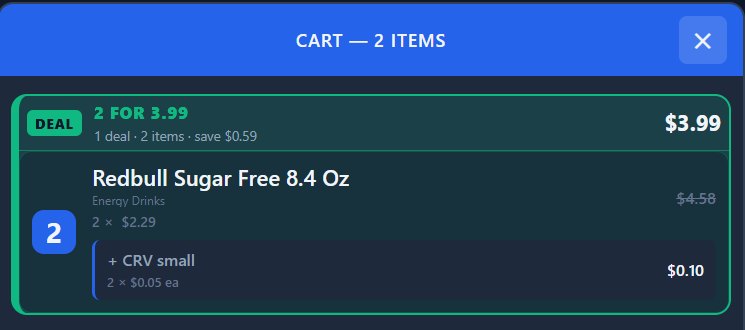
- One deal line on the receipt. Items at their regular price, the deal as one line with the saving, so the receipt adds up.
- Schedules. Start and end dates, days of the week and hours. Pause or restart any time.
- Priority. When two deals cover the same item, the higher priority one applies.
Measure it
After two weeks, check two things: did the units go up, and did the margin hold? In the Ceyyo phone app, the Promotions figure on the Sales page opens the sales that included a deal. If a deal isn't moving product, end it and try another.
Questions
- What's the difference between mix and match and a multi-buy?
- A multi-buy is a price for a number of items, like 2 for $6. Mix and match means the customer can combine different items to reach that number, like any two flavors of the same energy drink.
- Can one item be in two deals?
- It can be listed in two, but only one should apply. In Ceyyo, each deal has a priority, and when two deals cover the same item the higher one applies.
- How do deals show on the receipt?
- In Ceyyo, the items print at their regular price and the deal prints as one line with the saving, so the receipt adds up and the customer sees what they saved.
- Can I schedule a deal to start and end?
- Yes. A Ceyyo deal can have a start date, an end date, certain days of the week and certain hours, and you can pause it any time.